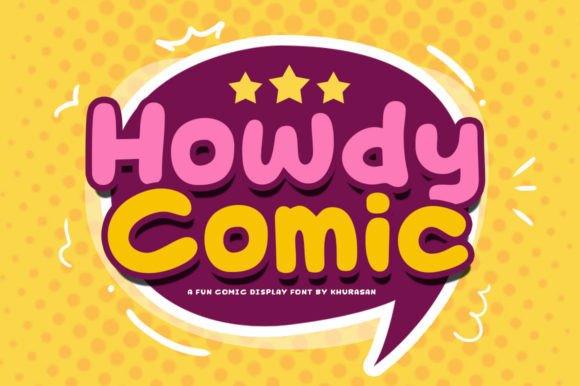
Howdy Comic: A Modern Display Font for Thoughtful Editorial Design
Last week, I sat down to refresh the cover layout for a seasonal recipe ebook—something warm, inviting, and quietly confident. The manuscript was finished; the photography edited; but the title treatment felt flat. I’d tried three clean sans serifs and two elegant serifs, each technically sound yet emotionally distant. Then I opened Howdy Comic, scrolled through its glyphs, and paused at the capital “H.” It wasn’t flashy—but it had presence: a gentle swell in the crossbar, a soft taper in the stem, just enough personality to feel human without sacrificing clarity. That’s when I knew: Howdy Comic wasn’t just another display font—it was the quiet collaborator my layout had been waiting for.
Howdy Comic for Recipe Ebook Covers and Print-Friendly Titles
For the recipe ebook, I set the title in Howdy Comic at 48pt on a cream background, paired with a light serif (Lora) for body text. The contrast worked beautifully: Howdy Comic carried warmth and approachability, while the serif grounded the page in readability and tradition. As a Display typeface, it shines where attention matters most—cover titles, chapter openers, ingredient headers—and its generous x-height and open counters hold up cleanly in both PDF exports and printed versions. Unlike many decorative fonts, Howdy Comic avoids visual noise: no exaggerated swashes or forced quirkiness. Instead, it offers rhythm—subtle variations in stroke weight, balanced spacing, and a gentle upward tilt that suggests friendliness without leaning into cartoonishness. That makes it especially effective for food-adjacent projects: wellness guides, seasonal planners, herbal remedy booklets—even illustrated grocery lists meant for sharing.
Howdy Comic for Lifestyle Blog Headers and Newsletter Graphics
I also tested Howdy Comic across digital touchpoints: the blog header, monthly newsletter banners, and Instagram story highlights. In web design, display fonts need to balance charm with performance—and Howdy Comic delivers. At 32–40px on desktop and scaled thoughtfully for mobile, it remains legible without hinting issues or rendering inconsistencies. I used it for the main headline above each post (“Morning Rituals,” “Slow Stitching,” “Herbal Tea Blends”) and found readers lingered longer on those pages—likely because the font’s gentle cadence invited pause, not distraction. As one of the more versatile Fonts in my library, Howdy Comic transitions seamlessly from screen to social: crisp in SVG exports, graceful in Canva templates, and stable in email clients when embedded as a web font or rasterized graphic.
Howdy Comic for Wedding Guides and Elegant Branding
A friend asked me to help format her digital wedding planning guide—a 36-page printable PDF with checklists, timeline visuals, and vendor contact sheets. She wanted something refined but not stiff, timeless but not traditional. Howdy Comic became the unifying thread: used for section headers (“Venue Considerations,” “Attire Timeline,” “RSVP Tracking”), pull quotes (“Your day should feel like *you*—not a Pinterest board”), and even subtle decorative dividers. Its elegance comes from restraint—not ornate flourishes, but considered proportions and consistent spacing. Because it’s a well-drawn Display font, it supports brand cohesion across formats: the same file works for print-ready PDFs, Notion templates, and Canva-based social previews. Just be sure to verify licensing—Howdy Comic is cleared for commercial use in client-facing deliverables, including paid digital products and editable templates.
Howdy Comic for Coaching Workbooks and Printable Planners
In a coaching workbook I designed last month, I reserved Howdy Comic for reflective prompts and milestone markers—“What does ease feel like this week?” or “Your First Big Win”—while using a neutral sans serif (Inter) for instructions and checkboxes. That hierarchy worked instinctively: Howdy Comic signaled invitation, not instruction. Its rounded terminals and soft joins create psychological openness—ideal for journals, habit trackers, and guided reflection sheets. As a Display font, it’s not intended for long paragraphs, but it excels in short bursts of meaning. When exporting printables, I checked that all glyphs rendered correctly in Adobe Acrobat and Preview, and confirmed that the included OTF files support standard Latin characters—perfect for English-language workbooks, though multilingual expansion would require checking alternate language support before international distribution.
Howdy Comic for Magazine Covers and Editorial Feature Pages
For a recent editorial feature on urban gardening, I used Howdy Comic as the masthead treatment across three spread layouts: a double-page cover, an opener with full-bleed photo and bold title, and a pull-quote sidebar. Its moderate contrast and friendly geometry made it legible at large sizes without overwhelming the imagery. Paired with a sturdy text face like Merriweather for body copy and a tight sans (DM Sans) for captions, Howdy Comic anchored the visual voice—modern, grounded, gently expressive. Among contemporary Fonts, few strike this balance between distinction and dignity. It doesn’t shout; it welcomes. And in magazine design—where first impressions happen in under three seconds—that quiet confidence is everything.
Howdy Comic for Book Covers and Banner Graphics
If you’ve ever wrestled with a book cover that feels either too safe or too chaotic, try Howdy Comic. I recently set a memoir title in it over a muted watercolor background—no effects, no shadows, just clean kerning and intentional leading. The result felt personal and polished, like handwriting refined by intention. As a Display font, it thrives in high-impact moments: banners for online courses, Etsy shop headers, conference slide titles, even embroidered tote bag lettering (when converted to vector). Just remember: always test at actual size. What reads beautifully at 72pt on screen may tighten unexpectedly in print—or soften too much on fabric. And before finalizing any project, confirm which file formats are included (OTF, WOFF, etc.) and whether the license covers your use case—especially for templates sold on Creative Market or Gumroad.
Ultimately, Howdy Comic isn’t about trend-chasing. It’s about choosing a Display font that supports your message—not overshadows it. Whether you’re designing a recipe ebook, a wedding guide, a coaching workbook, or a digital magazine, Howdy Comic brings warmth, clarity, and quiet sophistication. It’s the kind of Fonts that makes readers feel seen before they read a single word.